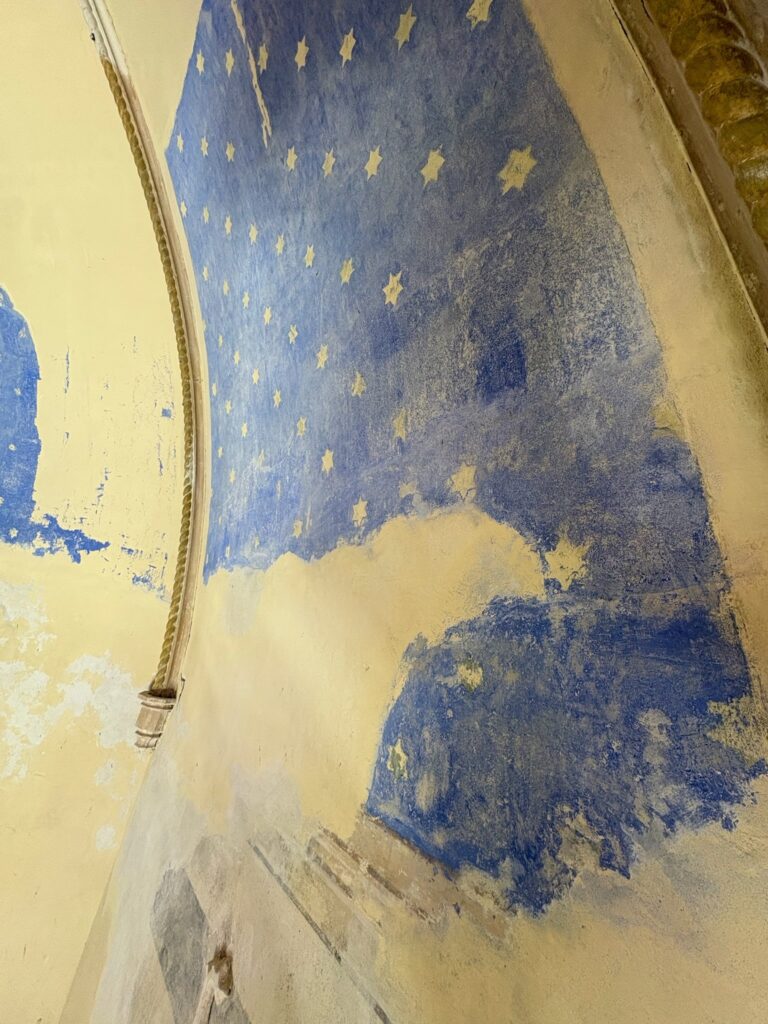
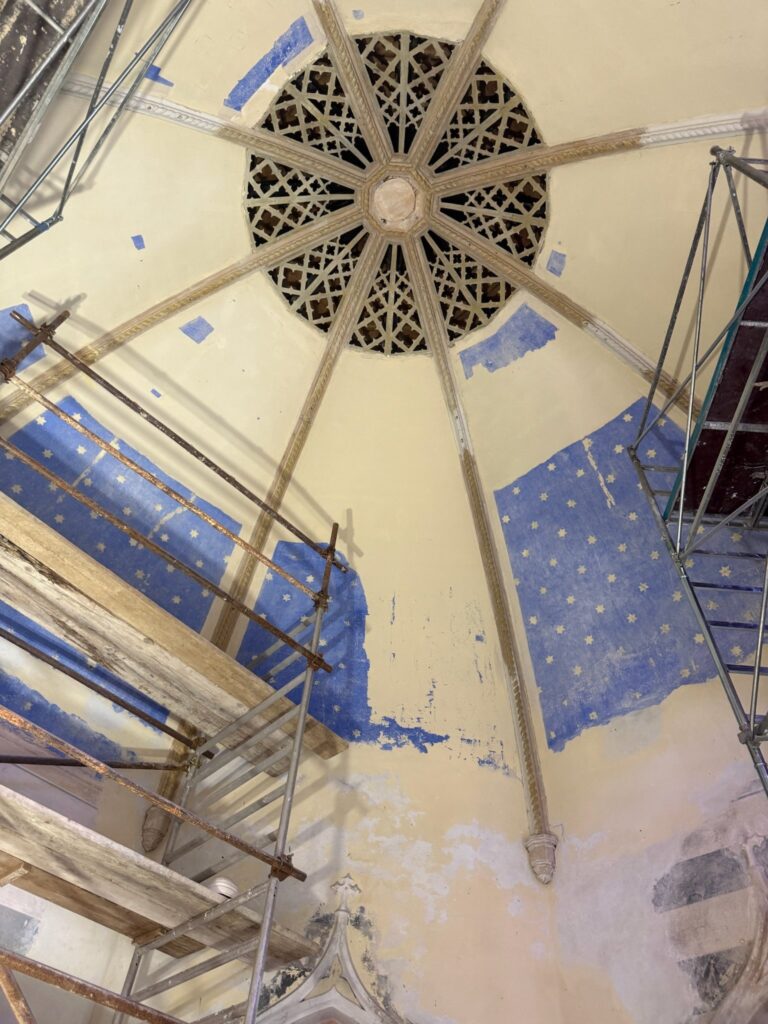
Since the end of August, conservation and restoration work has been underway inside the cemetery Church of Sts. Hermagoras and Fortunatus at Piran’s historic cemetery, gradually revealing its original 19th-century appearance. Beneath later layers of paint lie Neo-Gothic decorative murals featuring a blue starry sky, illusionistic architecture, and imitations of stone and marble.
For visitors to Piran, the project offers a new opportunity to discover a lesser-known but valuable part of the town’s cultural heritage.
A hidden 19th-century interior
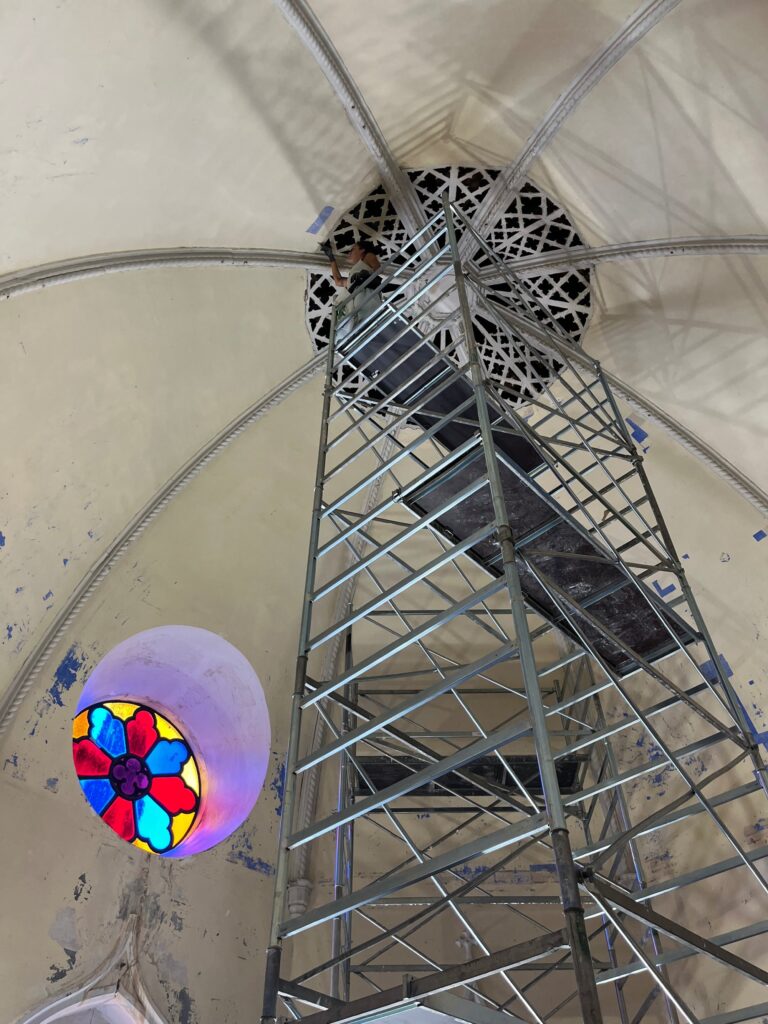
The Church of Sts. Hermagoras and Fortunatus was designed in the mid-19th century in the Neo-Gothic style. Its interior is characterised by moulded ribs, stucco elements and decorative murals that were repeatedly covered with new layers of paint over the decades.
Professional research has shown that the original secco paintings still survive underneath. Among the most distinctive motifs are a blue starry sky, illusionistic architecture, and paintings imitating stone and marble.
Despite localised damage, the original decoration is relatively well preserved, although it is very delicate in some areas. Particular challenges include poorly adhering paint layers and the flaking and powdering of later coatings.
Layer by layer towards the original appearance
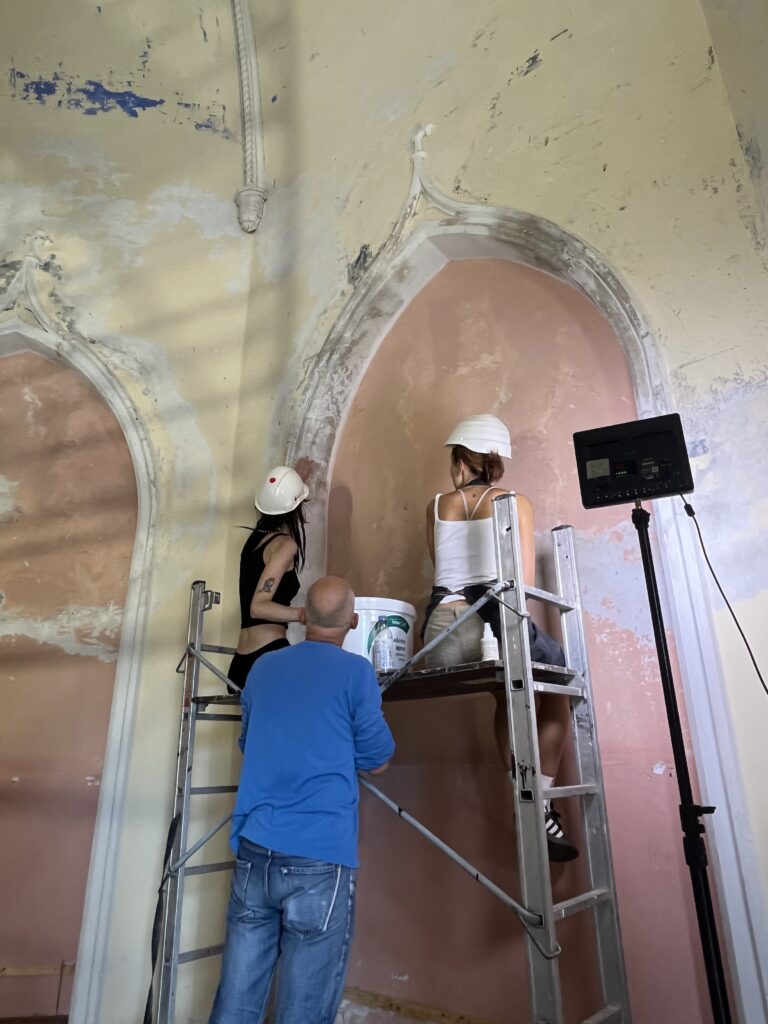
The main part of the restoration involves the gradual removal of later overpainting and the uncovering of the original decoration on the walls, vault and stucco elements.
Because the materials used vary, as does their state of preservation, restorers must adapt their methods to each individual surface. In some areas, later layers are removed mechanically with a scalpel, while elsewhere gentler methods are used to minimise intervention in the sensitive original layer.
The blue-painted vault with stars is particularly demanding, as the original paint layer there is especially fragile.
Alongside the uncovering of the murals, work also includes consolidating weakened paint layers, locally filling damaged areas and, where necessary, retouching and toning.
The aim of the restoration is not to create a new appearance for the church, but to preserve as much of the original decoration as possible and make its historic character legible to visitors once again.
Heritage preservation and training future restorers
The work is being carried out by a team from the Academy of Fine Arts and Design at the University of Ljubljana. Between six and eight conservation-restoration students are working on site under the mentorship of Assoc. Prof. Dr Blaž Šeme.
The project is therefore not only an important step in preserving Piran’s cultural heritage, but also a valuable practical experience for a new generation of conservators and restorers.
With at least five specialists present on site at all times, the work is expected to continue until the beginning of October, although it may be completed earlier if more conservators-restorers take part. The value of the conservation-restoration work is €24,725.20 excluding VAT.
Another reason to discover a lesser-known side of Piran
Piran’s historic cemetery, with its architecture, gravestones and the Church of Sts. Hermagoras and Fortunatus, represents an important yet often overlooked part of the town’s heritage.
The restoration offers a new insight into the church’s original Neo-Gothic appearance and also reminds visitors that many fascinating stories of Piran can be found beyond its most visited streets and squares.