I arrived in Piran without a specific plan. Perhaps it was just that silent call of the city—the kind we often miss when rushing through our daily lives. You know that feeling when you just need a few hours of peace? To wander through narrow alleys, surrender to the cries of seagulls, the rhythm of waves against the rocks, and the distant hum of local chatter? If you ever feel the need to simply “get lost,” Piran is the ideal place.
Join me as we explore Piran a little differently.
The easiest way to reach Piran is by bus, which takes you from Portorož or Lucija to the city’s main station. From there, you can head toward Tartini Square either by walking along the coast or weaving through the inner streets. The choice is yours.
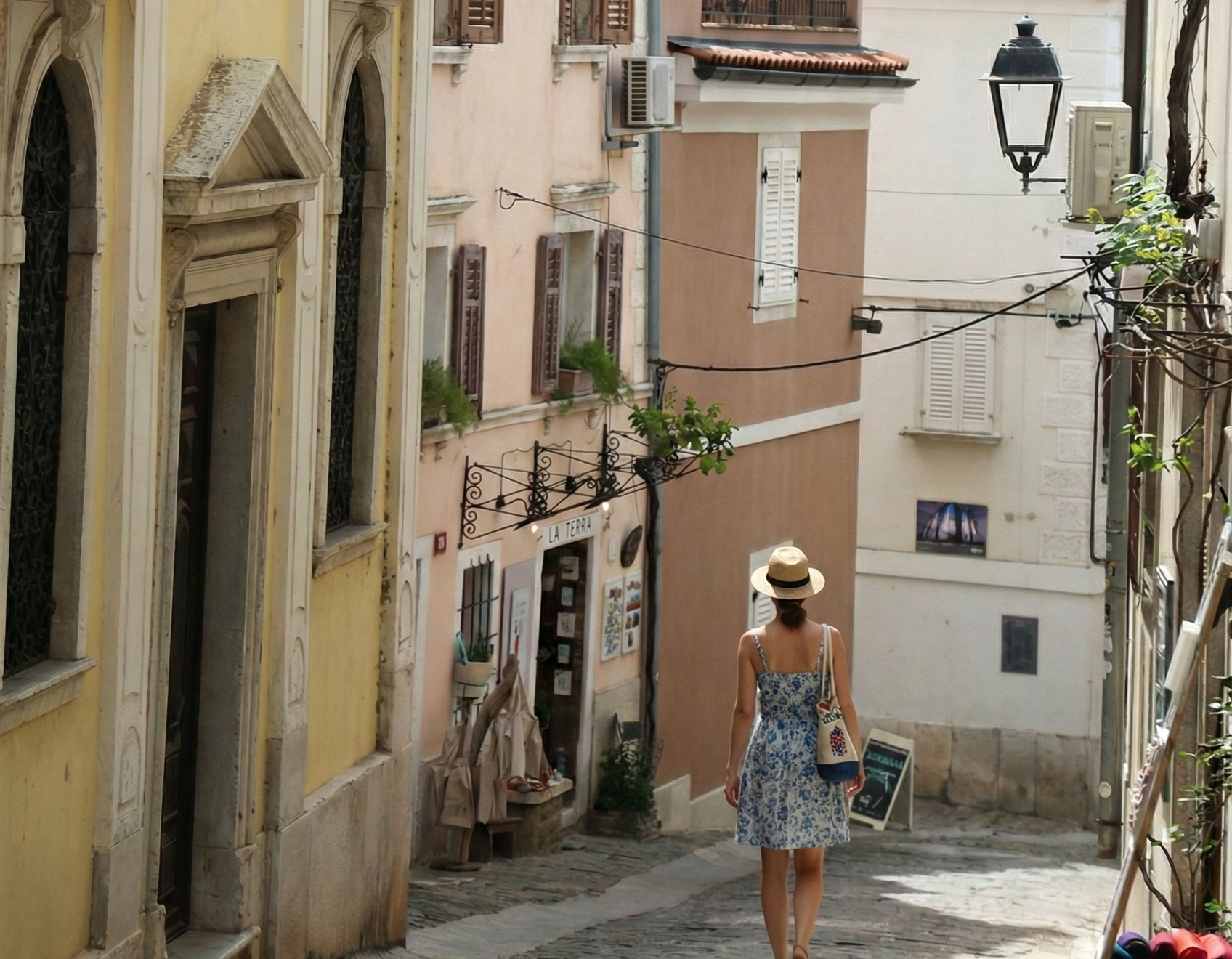
Piran’s streets are vibrant and full of life. You’ll see colorful facades of tall, narrow houses, windowsills overflowing with flowers, and charming boutiques filled with handmade treasures. To me, Piran is most beautiful in the early summer mornings, when the light slowly filters through the alleys, illuminating hidden corners. One such spot is a small park halfway to Tartini Square. Visit it, take a seat on a bench, and just listen. To your left, you’ll see and hear the sea; to your right, locals going about their morning routines. If you’re lucky, you’ll even hear birdsong in the treetops.
Piran: A Cradle of Art and Galleries
Piran has always been synonymous with art. I’m not just talking about the City Gallery, the Herman Pečarič Gallery, or the various Ex-tempore events held here and in the hinterland, but also its rich musical and cultural history. After all, this is the home of the violin virtuoso Giuseppe Tartini.
Before you reach Tartini Square—if you’re walking along the coast—you’ll spot a red building on your right: the Herman Pečarič Gallery. It is named after one of Istria’s most significant painters, who captured olive trees, Istrian landscapes, and the everyday lives of locals with incredible sensitivity. The gallery bears his name because the artist bequeathed his extensive legacy to the city, making Piran the guardian of his artistic vision and Istria’s cultural heritage.
When you reach Tartini Square, I suggest you pause for a moment. Take in the interesting ellipse of the square and the buildings that surround it, looking as if they are standing guard. In the center, in all its majesty, stands the monument dedicated to Giuseppe Tartini. The statue of the violinist and composer was erected on August 2, 1896, marking the 200th anniversary of his birth. It stands where the inner harbor, or mandrač, used to be. It wasn’t until 1894 that it was filled in for hygienic reasons, creating the square we know today.
Can I let you in on a secret?
For 120 years, no one knew that the Venetian sculptor Antonio dal Zotto had etched an emotional dedication to his late wife, Ida, onto the edge of the bronze violin. It was only discovered in 2016 during a restoration involving 3D scanning. The inscription reads: “Ida Lessiach Naya dal Zotto – good, wise, beautiful, taken by God.” Ida had advised the sculptor during the creation of the statue, but sadly passed away before its unveiling.
In Tartini Square, you can also visit the Tartini House, the Piran City Gallery, the Magical World of Shells, the Morigenos exhibition, and the “Benečanka” (The Venetian House)—arguably the most famous house in the city.
Venetian Charm and Handmade Memories
Walk up IX. Korpus Street and explore the tiny shops that will enchant you with beautiful handmade crafts. Among them is a boutique featuring tiny houses made from driftwood, crafted by Nika (Nika’s Tiny House). If your heart beats faster for clay, you won’t be disappointed either. Piran is home to several ateliers where exquisite ceramics and porcelain pieces come to life.
The path along IX. Korpus Street led me almost naturally upward toward the Church of St. George, which watches over the town. This stunning Venetian church, with its bell tower—a smaller replica of St. Mark’s Campanile in Venice—houses precious wooden crucifixes and Venetian Baroque splendor. But the real magic happens outside, on the church lawn. From here, under the watchful eye of the bronze Archangel Michael (who acts as a weather vane atop the tower), Piran finally opens up in every direction. Tartini Square appears as a perfect ellipse tucked between rooftops and various chimneys, while on the horizon, the silhouettes of the Croatian coast and Trieste blend together. On a clear day, if you’re lucky, you can even see the snow-capped Alps in the distance.
Experience Piran Like a Local
Head down from the church toward the “Punta” (the tip of the peninsula). And don’t worry—if our burja wind brushes against your cheeks, your trip to Piran will still be bathed in sunshine. If you visit in the summer, the Punta becomes a colorful backdrop of beach towels spread over the rocks, divers exploring the seabed, and a lively mix of locals and tourists.
Piran is magnificent, and there are many more picturesque spots to see, but believe me: find a small café near the Punta, treat yourself to a glass of Istrian wine or a refreshing drink, and just enjoy. Surrender to the sun’s rays, the blue of the sea, the cry of the gulls, and the city’s hum. Try to experience Piran like a local—don’t rush, feel it with your whole being. We often experience a place best by simply letting go and embracing the peace that the moment brings.
And believe me, Piran is truly the place for that.